
The Death Zone on Mount Everest: Location, Risks, and Survival
The Death Zone on Mount Everest: Where Survival Becomes a Battle
High in the towering Himalayas lies one of the most extreme environments on Earth—a place climbers both dream of reaching and fear encountering. Known as the “death zone,” this part of Mount Everest represents the final and most dangerous stage of any Everest expedition. It is a region where the human body begins to fail, oxygen is scarce, and even the smallest mistake can be fatal.
In this in-depth guide, we’ll explore exactly where the death zone is on Everest, why it is so dangerous, and what climbers face when they enter it.
What Is the Death Zone?
The term “death zone” refers to altitudes above 8,000 meters (26,247 feet). This concept applies not only to Everest but to all peaks in the Himalayas and other mountain ranges around the world that exceed this elevation.
At this height, atmospheric pressure drops so low that there is only about one-third of the oxygen available at sea level. The human body cannot acclimatize to these conditions indefinitely. Even with supplemental oxygen, survival is limited to a short period—usually no more than 16 to 20 hours for most climbers.
Where Is the Death Zone on Everest?
On Mount Everest, the death zone begins at approximately 8,000 meters. This zone includes:
•Upper section of the South Col route (from Camp IV)
•The Southeast Ridge
•Hillary Step area (though altered after earthquakes)
•Summit itself at 8,848.86 meters
Most climbers enter the death zone after reaching Camp IV, which sits at around 7,900 to 8,000 meters on the South Col. From here, they begin their final push to the summit—usually at night—aiming to reach the top and descend before conditions deteriorate.
Why Is It Called the Death Zone?
The name is not an exaggeration. The death zone is so called because the human body literally begins to die at this altitude.
1. Lack of Oxygen
The primary danger is hypoxia—a severe lack of oxygen. At this height, every breath delivers far less oxygen to the lungs. This leads to:
•Confusion and poor judgment
•Loss of coordination
•Extreme fatigue
•Slowed reaction time
Even simple tasks like clipping into a rope or adjusting equipment can become difficult.
2. Cellular Breakdown
Above 8,000 meters, the body cannot repair itself. Cells begin to break down, and vital organs are placed under enormous stress. Climbers may experience:
•Muscle wasting
•Weakness
•Reduced mental clarity
This is why prolonged stays in the death zone are impossible.
3. High Risk of Fatal Illnesses
Two life-threatening conditions are common in the death zone:
•High Altitude Pulmonary Edema (HAPE): Fluid builds up in the lungs
•High Altitude Cerebral Edema (HACE): Brain swelling due to fluid accumulation
Both conditions can rapidly become fatal if the climber does not descend immediately.
4. Extreme Weather Conditions
The weather in the death zone is unpredictable and brutal:
•Temperatures can drop below -30°C
•Winds can exceed 100 km/h
•Sudden storms can trap climbers
The infamous jet stream often sweeps across Everest’s summit, making conditions even more dangerous.
5. Limited Rescue Options
Rescue operations above 8,000 meters are nearly impossible. Helicopters cannot safely reach these heights, and fellow climbers often lack the strength to assist others.
This harsh reality means that climbers must be self-reliant.
The Route Through the Death Zone on Mount Everest
Most climbers approach Everest from the Nepal side, passing through Everest Base Camp before ascending through several camps.
Camp IV (South Col)
•Altitude: ~7,900–8,000 meters
•Gateway to the death zone
•Final staging point for summit push
From here, climbers rest briefly, hydrate, and prepare their gear before heading into the death zone.
The Balcony
•A small resting point around 8,400 meters
•Climbers often change oxygen tanks here
The South Summit
•Around 8,750 meters
•Offers a false sense of achievement before the final ridge
Summit Ridge and Summit
•Narrow, exposed ridge with steep drops
•Final push leads to the summit of Mount Everest
Reaching the top is only half the journey—the descent is often more dangerous.
How Long Do Climbers Stay in the Death Zone on Mount Everest?
Climbers aim to minimize time spent above 8,000 meters. A typical summit push looks like this:
•Depart Camp IV around 8–10 PM
•Reach the summit early morning
•Descend back to Camp IV or lower the same day
Spending too long in the death zone significantly increases the risk of death.
Real Dangers and Tragic History
The death zone has claimed many lives over the years. One of the most well-known tragedies occurred during the 1996 Mount Everest disaster, when a sudden storm trapped climbers near the summit, leading to multiple fatalities.
Today, climbers may also encounter the bodies of those who perished in the death zone. Due to the extreme conditions, recovery is often impossible.
The Role of Supplemental Oxygen
Most climbers use bottled oxygen to increase their chances of survival. Oxygen systems:
•Improve mental clarity
•Reduce fatigue
•Increase chances of reaching the summit
However, oxygen is not a guarantee of safety. Equipment failure or running out of oxygen can quickly become life-threatening.
Mental Challenges in the Death Zone of Mount Everest
Beyond physical dangers, the death zone tests mental strength.
Climbers often face:
•Hallucinations
•Panic or anxiety
•Decision fatigue
The ability to remain calm and focused can mean the difference between life and death.
Traffic Jams in the Death Zone on Mount Everest
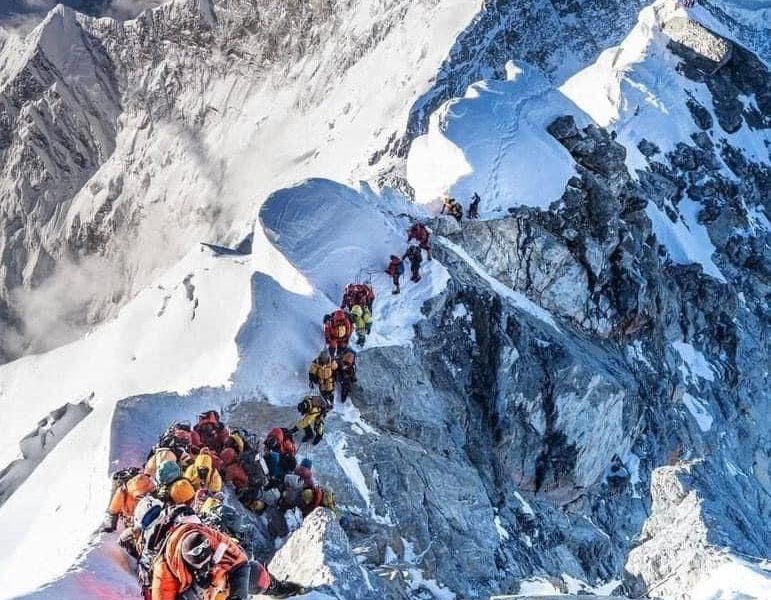
In recent years, overcrowding on Everest has become a serious issue. Long queues of climbers can form near the summit, forcing individuals to wait in the death zone longer than planned.
This increases risks such as:
•Running out of oxygen
•Exposure to extreme cold
•Delayed descent
Proper expedition planning and timing are crucial to avoid these dangers.
How Climbers Prepare for the Death Zone On Mount Everest
Preparation is key to survival.
1. Acclimatization
Climbers spend weeks gradually ascending and descending to adapt their bodies to high altitude.
2. Physical Fitness
Extreme endurance, strength, and stamina are essential.
3. Technical Skills
Climbers must be proficient in:
•Using ropes and harnesses
•Navigating icy terrain
•Handling oxygen equipment
4. Experienced Guides
Many expeditions rely on experienced Sherpa guides who play a vital role in safety and logistics.
Why Do Climbers Still Go if Death Zone on Mount Everest?
Despite the dangers, thousands attempt Everest each year. The reasons vary:
•Personal challenge
•Adventure and exploration
•Prestige of summiting the world’s highest mountain
For many, standing on top of Mount Everest is a lifelong dream.
Is the Death Zone Avoidable?
No. Reaching the summit of Everest requires passing through the death zone. There is no alternative route that bypasses this extreme altitude.
However, climbers can reduce risks by:
•Choosing experienced operators
•Monitoring weather conditions
•Maintaining strict turnaround times
Final Thoughts
The death zone on Mount Everest is one of the most unforgiving environments on Earth. It is a place where nature sets the rules, and human survival hangs by a thread.
Understanding its risks is essential—not just for climbers, but for anyone fascinated by high-altitude exploration. The death zone is a reminder of both the limits of the human body and the extraordinary determination of those who dare to push beyond them.
For those who enter it, the goal is simple: reach the summit—and make it back alive.