Trip overview
Everest Base Camp Shortest Trek Overview
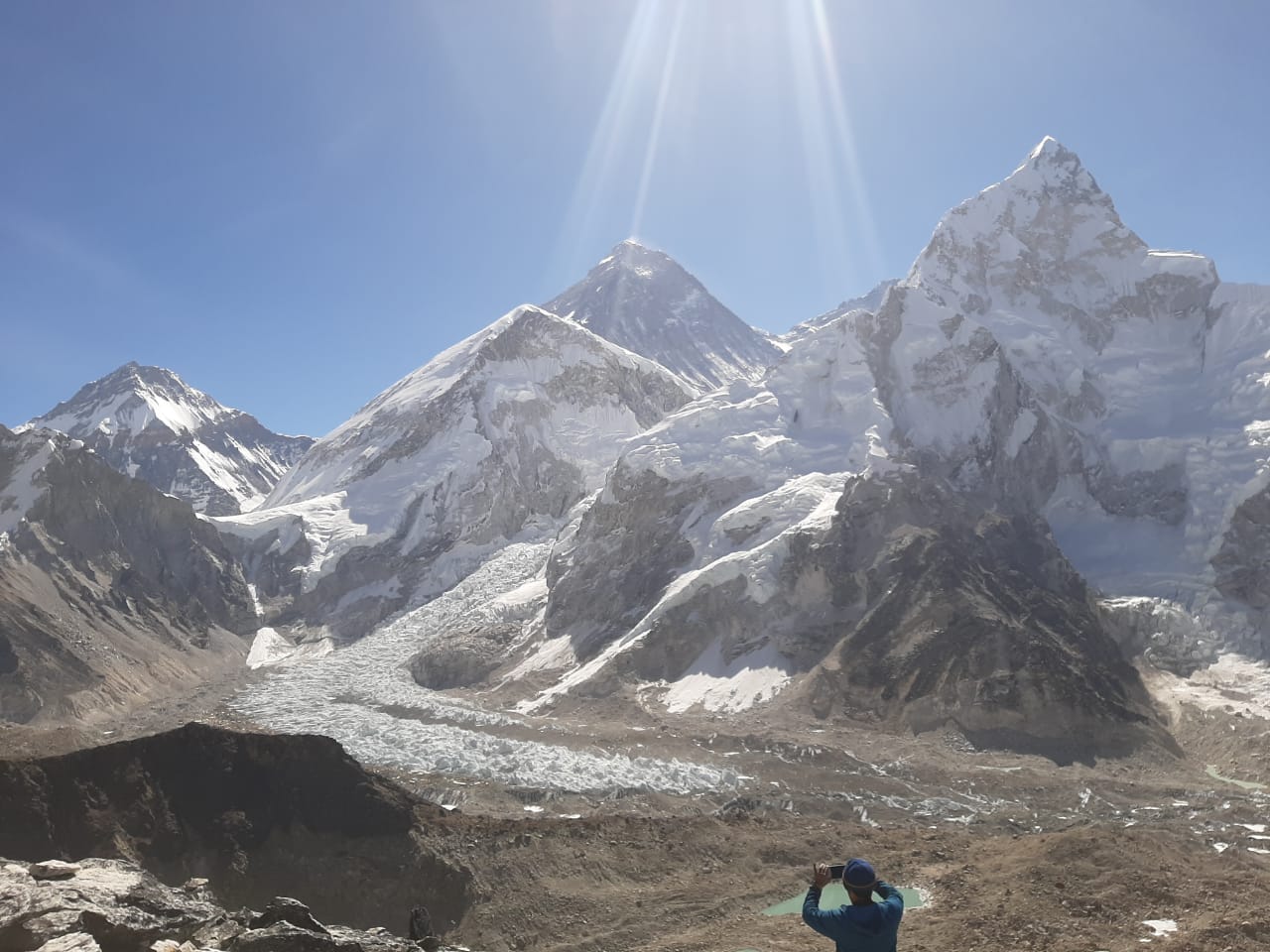
If you have short timeframe but physically fit then 9 days short Everest Base Camp Trek is a your ideal trip to explore Everest Region. During the 9 days of Excellent Everest Base Camp Shortest Trek, you will see more than 42 snow-capped peaks over the 6000m. In addition, the view includes the 4 highest mountains over eight thousand meters in height. These mountains are Mt. Everest, Mt. Makalu, Mt. Lotshe, and MT. Cho Oyu. Moreover, you get a chance to witness rare breeds of animals and vegetation. The trail is home to numerous birds too. Consequently, trekkers can experience mountains as well as nature’s wonderful creations.
Reaching the base camp of the world’s tallest mountain is not considered complete without consideration of altitude, overall trekking experiences, and proper trekking itinerary. Therefore, our travel planners spent hours with locals, past trekkers, and experienced trekking guides to create the Everest Base Camp Shortest Trek itinerary. There’s no doubt that the trek itinerary is scientific and encompasses all highlights of the EBC Trek in Nepal.
Is the 9-Day Everest Base Camp Trek Suitable for You?
This 9-day Everest Base Camp Trek is a fast-paced and challenging itinerary designed for physically fit and experienced trekkers with limited time. Unlike the standard Everest Base Camp itinerary, it does not include dedicated acclimatization days. As a result, the rapid gain in altitude makes this trek more demanding. Particularly at higher elevations, it is more challenging.
Trekkers should be prepared for long walking days and should follow their guide’s advice regarding altitude, hydration, rest and overall health. If altitude-related symptoms worsen, continuing to ascend is not recommended.
Some travelers even mention the Everest Base Camp Shortest Trek as the Express EBC Trek. To prepare, make sure that you have good physical fitness level and proper cardio – vascular abilities. Build up these traits at least one month prior to the trek. Perform activities like running, swimming, walking, hiking, and cycling to boost fitness and cardio – vascular abilities. Furthermore, you can also follow strict dietary patterns to ensure successful nonstop 9 Days Everest Base Camp Trek in Nepal.
Leave your footprints at the amazing base camp of Mt. Everest in the 9-day!
There are rarely a few places in the world with such a splendid variety of natural beauty as the Mt Everest region. It is a rare combination of mountains, nature, and culture. Everest region’s trekking offers long ranges of snow-capped mountains, crystal clear lakes, turbulent rivers, Buddhist monasteries, mane walls as well as typical Sherpa Houses. During the Everest short trek, you will go through the beautiful rhododendron forest. Moreover, you will cross the Pristine Rivers, see naturally decorated landscapes and encounter several rare and non-rare animals and birds inside the Sagarmatha National Park.
Trekking to Everest Base Camp is not only about gathering the Himalayan adventure experiences in an abode of the world’s tallest mountain, Mt. Everest (8848.86 m). It is also about learning culture, traditions, and daily lifestyles of Sherpa People. Moreover, understand that the Sherpa people are known across the globe as the legends of mountaineering. In fact, the prowess of climbing mountain and tackling higher elevation places are the traits of the Sherpa People.
9 Days EBC Itinerary for Limited time travelers
Moreover, the route of the Everest base camp shorter Path goes through the villages of the Sherpa people. So, during the 9 days of the Everest base camp nonstop Quest, you will know culture. Trekkers can get a chance to know the festivals like Loshar, Dumji, Fangi, Yarchyang, etc. We designed the Everest base camp Short treks itinerary by including the general route and minimum required days.
Nowadays, people may not have long vacations. Therefore, they are in constant search for a trek itinerary that is less than 10 days. If you wish to include luxury helicopter return, then you can do the trek in just 7 days too! The choice is yours. In addition, contact the travel planners of the Himalaya View Treks Pvt. Ltd. to book luxury Short Everest Base Camp Trek package with helicopter return option.
Is it safe to do the Everest Base Camp Trek without acclimatization?
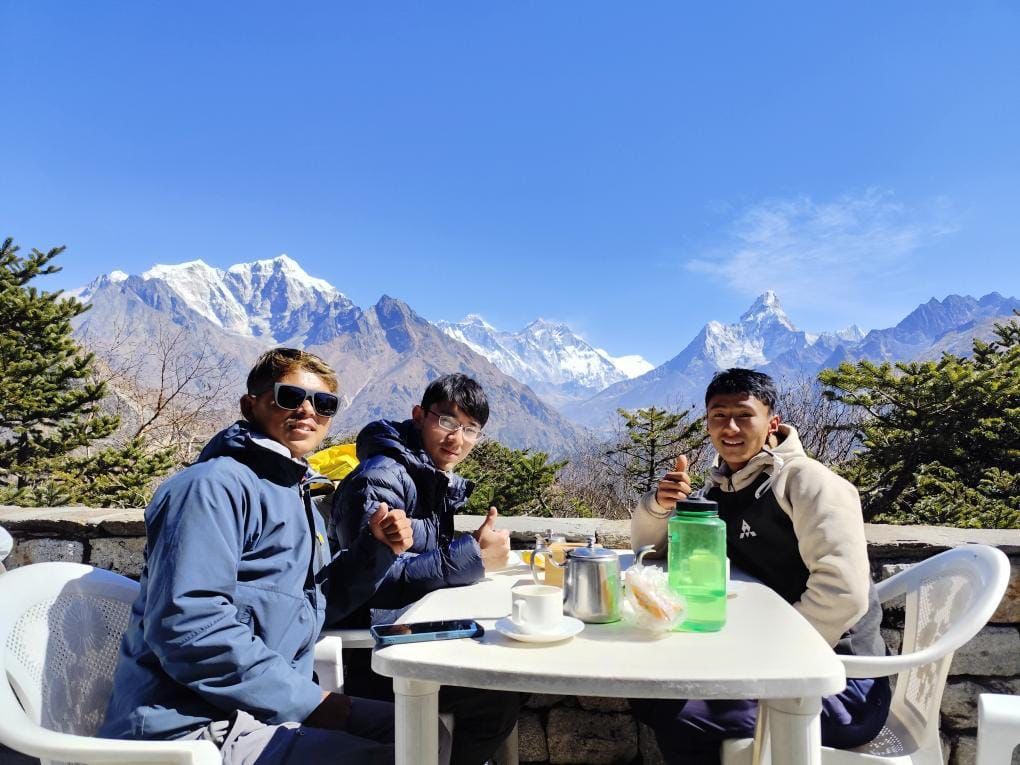
Well, on normal circumstances, it is not highly recommend to do the Everest Base Camp Trek without acclimatization activities. During the regular Everest Base Camp Trek in Nepal, trekkers spend two nights in Namche Bazaar. Additionally, they spend two nights in Dingboche Village. It is for acclimatization activities. The first one includes hike to the Everest View Hotel (3880 m) and the second one includes the Nagarshan Hill (5100 m) hike. These two activities ensure that you are fully adjusted to the demands of the higher elevation places. However, the Everest Base Camp Short Trek doesn’t have acclimatization activities.
If you are following proper trekking guidelines (eating, drinking, and walking pattern), then you can surely do the Everest Base Camp Trek in Nepal. Interestingly you can do without acclimatization breaks. Our travel planners prepared the Everest Base Camp Shortest Trek with view to cater trekkers with strong cardio – vascular abilities and good physical fitness level. EBC Short Trek package is not suitable for beginner trekkers.
Why Himalaya View Treks for EBC Trek in Nepal?
It is no exasperation to share that the Himalaya View Treks Pvt. Ltd. doesn’t leave a single stone unturned while serving trekkers. From trek’s logistics management to providing authentic information, the agency is highly skilled and experienced. Look no further than us for a hassle free journey to the foothill of the world’s tallest mountain, Mt. Everest (8848.86 m). Lace up your boots to embark on this enticing Himalayan adventure journey in Khumbu Nepal.
Remember us if you are pondering the short Everest Base Camp journey in limited time. HVT guide porters will be available all around the year. The best Trek Season times of the year are September, October, November, and March, April, and May. We have an excellent team of travel planners. Therefore, our trips are scientific and worthwhile. Knit the best memory of the Everest region by holidaying for just 9 days voyage.
Alternative / Side Trip Recommendations
If you want to explore more of the Gokyo valley and its high-altitude lakes, consider adding or taking the Fifth Lake Trek for breathtaking views of Everest’s massive Ngozumpa Glacier and surrounding peaks.
Looking to avoid the flight to Lukla? Check out our Everest Base Camp Trek from Surke – 13 Days, or Everest Base Camp Trek from Phaplu Route. which offers a scenic drive and trek alternative starting from Surke.
Alternative Trek: Annapurna Base Camp
Want to experience a different side of the Himalayas? The Annapurna Base Camp Short Trek – 7 Days is a great alternative to the Everest Base Camp Shortest Trek. This journey takes you through charming mountain villages, peaceful forests, and scenic valleys, gradually leading to the spectacular Annapurna Base Camp at 4,130 meters. It is a rewarding choice for trekkers looking for a shorter Himalayan adventure with diverse landscapes and close-up mountain views.
Short Itinerary
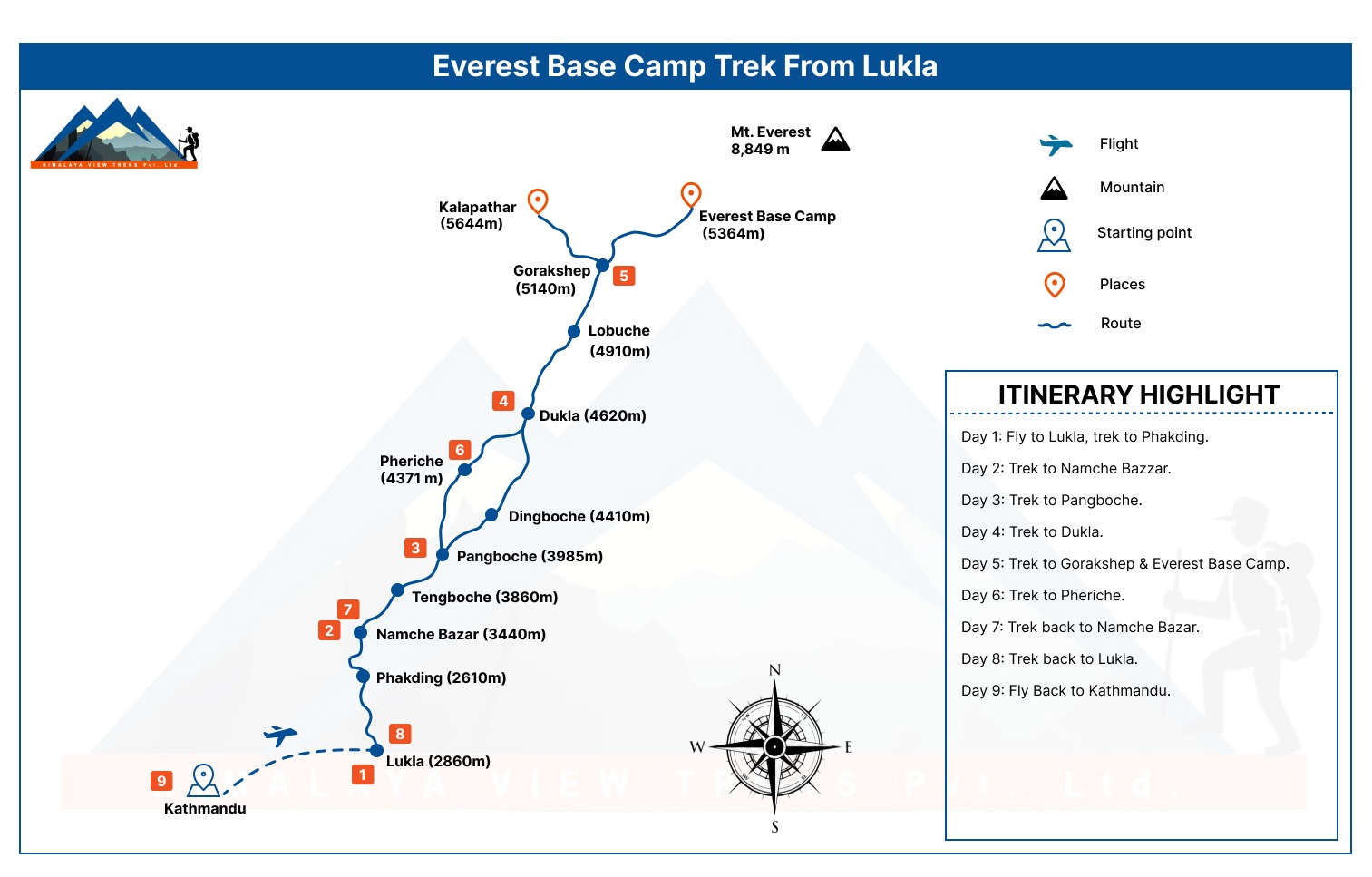
Short Everest Base Camp Itinerary - 9 Days
Day 1: Fly to Lukla from Kathmandu, trek to Phakding walking distance of 2/3 hours (2610 M / 8,664 ft)
Day 2: Phakding to Namche Bazaar walking distance of 6/7 hours (3440 m / 11290 ft)
Day 3: Namche Bazaar to Pangboche walking distance- of 15km. 5 to 6 hours trek (3930 m/12890 ft)
Day 4: Pangboche to Dukla walking distance is 13km (7 hours)4,680 m/15,435 ft
Day 5: Trek From Dukla to Gorakshep walking distance is 11 km (6-8 hours) (Gorakshep) 5180 m/16,994 ft & Everest Base Camp 5364 m/17598 ft
Day 6: Gorakshep to Pheriche walking distance 13km (5-6 hours)5,545m/18,192ft (Kalapathar) & 4,320 m/14,173 ft (Pheriche
Day 7: Pheriche to Namche Walking Distance 14.2 km (5-6 hours) 3440m/11285ft
Day 8: Namche to Lukla Walking Distance 13km (5-6 hours) 2,800 m 9,100 ft
Day 9: Fly back to Kathmandu, Altitude of Kathmandu (1300m) (35 minutes). We woke up early for our flight back to Kathmandu.
Detailed Itinerary
Day 1: Fly from Kathmandu to Lukla and Trek to Phakding
Flight time: Approximately 30–35 minutes
Trek: Approximately 3–4 hours
Altitude: Lukla 2,840 m/9,318 ft → Phakding 2,610 m/8,563 ft
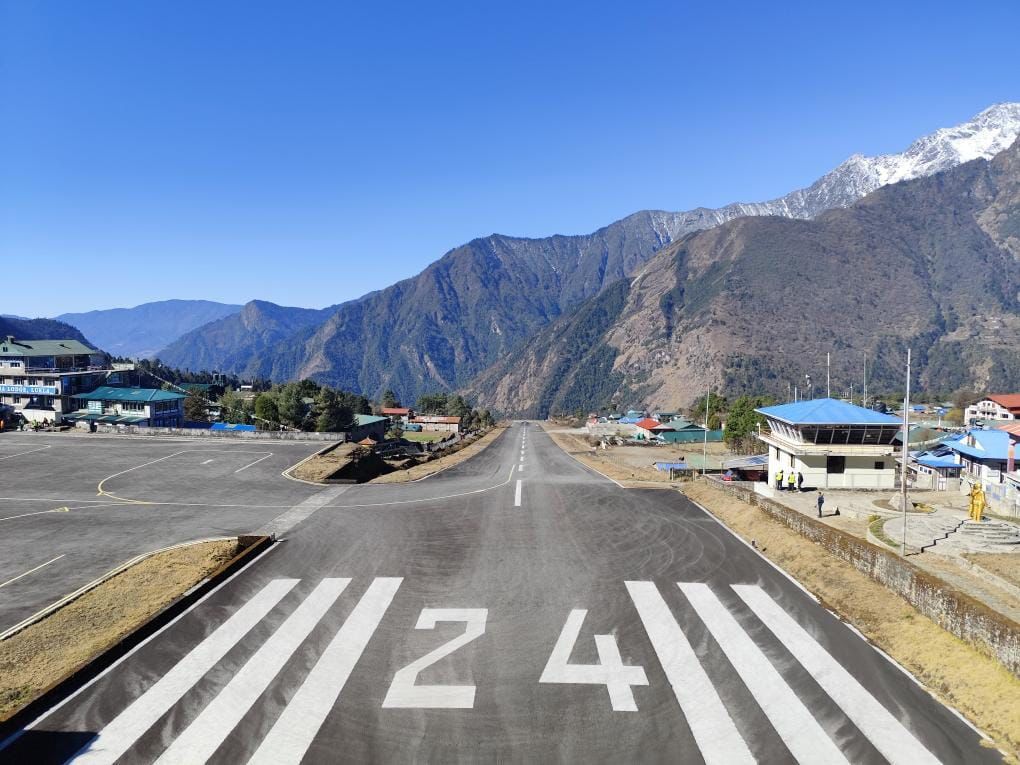
Take an early morning flight from Kathmandu to Lukla. After landing at Lukla, meet your trekking crew and begin the trek toward Phakding. The trail follows the Dudh Koshi Valley through small mountain settlements and scenic landscapes. After reaching Phakding, check into your teahouse and rest for the evening.
Overnight: Teahouse in Phakding
Meals: Breakfast, Lunch & Dinner
Day 2: Trek from Phakding to Namche Bazaar
Walking distance: Approximately 10–12 km
Trekking time: Approximately 5–7 hours
Altitude: Namche Bazaar 3,440 m/11,286 ft
Continue along the Dudh Koshi River, crossing several suspension bridges before entering Sagarmatha National Park. The trail passes through Monjo and Jorsale before following the river toward the Hillary Suspension Bridge. From there, the trail climbs steadily to Namche Bazaar, the main trading center of the Khumbu region.
Overnight: Teahouse in Namche Bazaar
Meals: Breakfast, Lunch & Dinner
Day 3: Trek from Namche Bazaar to Pangboche
Walking distance: Approximately 15 km
Trekking time: Approximately 5–6 hours
Altitude: Pangboche 3,930 m/12,894 ft
Leave Namche Bazaar after breakfast and follow the scenic trail toward Pangboche. The route offers spectacular views of Mount Everest, Lhotse, Ama Dablam, Thamserku and other Himalayan peaks. The trail descends toward the Dudh Koshi River before climbing through rhododendron and pine forests. Continue through traditional Sherpa settlements and pass several Buddhist mani walls and prayer stones before reaching Pangboche, one of the oldest permanent settlements in the Khumbu region.
Overnight: Teahouse in Pangboche
Meals: Breakfast, Lunch & Dinner
Day 4: Trek from Pangboche to Dukla
Walking distance: Approximately 13 km
Trekking time: Approximately 6–7 hours
Altitude: Dukla/Thukla area, approximately 4,620 m/15,157 ft
After breakfast, continue toward the higher elevations of the Khumbu Valley. The trail follows the Imja Valley before joining the route toward Dingboche and the Thukla area. As the altitude increases, the landscape becomes more rugged and vegetation becomes increasingly sparse. Continue toward Dukla and enjoy views of the surrounding Himalayan peaks before settling into your teahouse for the night.
Overnight: Teahouse in Dukla/Thukla
Meals: Breakfast, Lunch & Dinner
Day 5: Trek from Dukla to Gorakshep and Everest Base Camp
Walking distance: Approximately 11 km
Trekking time: Approximately 6–8 hours
Altitude: Gorakshep 5,180 m/16,995 ft
Everest Base Camp: Approximately 5,364 m/17,598 ft
Start early and continue toward Gorakshep. The trail climbs toward the Thukla Pass memorial area, where memorials honor climbers and mountaineers who lost their lives in the Himalayas. From there, continue through the increasingly rugged landscape toward Lobuche and onward to Gorakshep.
After reaching Gorakshep and taking a short break, continue toward Everest Base Camp. The trail crosses rocky and glacial terrain alongside the Khumbu Glacier. At Everest Base Camp, enjoy views of the Khumbu Icefall and surrounding Himalayan peaks. After spending some time at the base camp, return to Gorakshep for the night.
Overnight: Teahouse in Gorakshep
Meals: Breakfast, Lunch & Dinner
Day 6: Hike to Kala Patthar and Trek to Pheriche
Day 6: Hike to Kala Patthar and Trek to Pheriche
Walking distance: Approximately 13 km
Trekking time: Approximately 6–8 hours
Highest point: Kala Patthar 5,545 m/18,192 ft
Overnight altitude: Pheriche approximately 4,371 m/14,340 ft
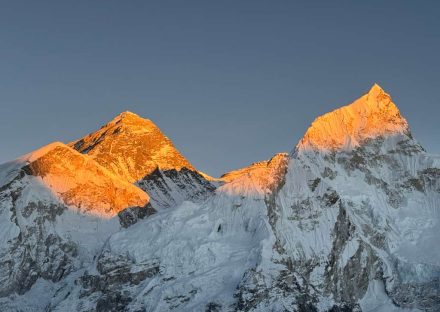
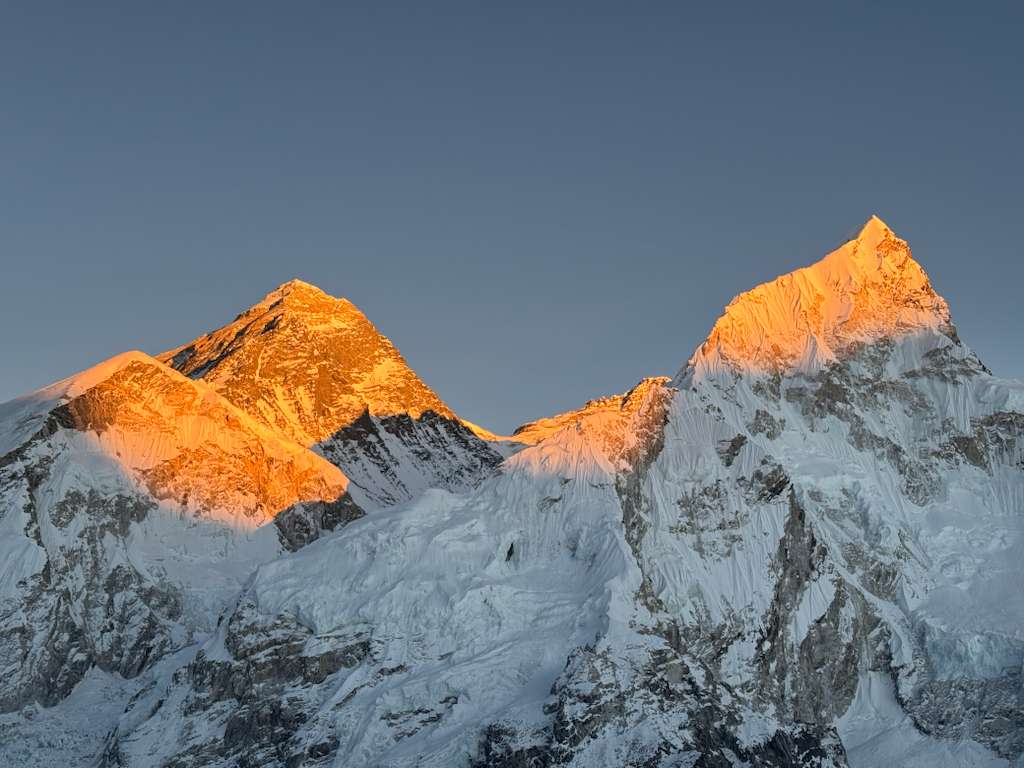
Start early in the morning for the challenging hike to Kala Patthar, the highest point of the trek. From the viewpoint, enjoy spectacular panoramic views of Mount Everest, Lhotse, Nuptse, Pumori and the surrounding Himalayan peaks. The early morning light can provide excellent mountain views, although visibility depends on weather conditions.
After returning to Gorakshep, have breakfast and begin the descent toward Pheriche. The trail follows the Khumbu Valley through the high mountain landscape before reaching Pheriche. The significant descent provides some relief after several days at high altitude.
Overnight: Teahouse in Pheriche
Meals: Breakfast, Lunch & Dinner
Day 7: Trek from Pheriche to Namche Bazaar
Walking distance: Approximately 14–15 km
Trekking time: Approximately 5–7 hours
Altitude: Namche Bazaar 3,440 m/11,286 ft
After breakfast, begin the descent toward Namche Bazaar. Follow the trail through Pangboche and Tengboche before continuing through rhododendron and pine forests. The route follows the Dudh Koshi Valley and crosses several suspension bridges along the way. After a steady descent and a final climb, arrive at Namche Bazaar. Enjoy a well-earned rest and your final evening in the Khumbu region.
Overnight: Teahouse in Namche Bazaar
Meals: Breakfast, Lunch & Dinner
Day 8: Trek from Namche Bazaar to Lukla
Walking distance: Approximately 13 km
Trekking time: Approximately 5–7 hours
Altitude: Lukla approximately 2,840 m/9,318 ft
After breakfast, begin the final trekking day of the journey. Descend from Namche Bazaar through the Dudh Koshi Valley, passing through Jorsale, Monjo and Phakding. Continue along the familiar trail toward Lukla. After arriving in Lukla, check into your teahouse and enjoy your final evening in the Everest region with your trekking team.
Overnight: Teahouse in Lukla
Meals: Breakfast, Lunch & Dinner
Day 9: Trek from Namche Bazaar to Lukla and Fly to Kathmandu
Trekking time: Approximately 6–8 hours
Altitude: Lukla 2,840 m/9,318 ft
After an early breakfast, begin the final trek toward Lukla. Follow the Dudh Koshi Valley through Jorsale, Monjo and Phakding before making the final climb toward Lukla. Depending on the flight schedule and operating conditions, fly from Lukla to Kathmandu. Upon arrival in Kathmandu, transfer to your hotel.
Meals: Breakfast & Lunch
Included
- Airport pickup and drop as per client’s arrival and departure date
- Hotel- domestic airport- hotel by car/ van, depend on group sizes
- Domestic flights (Kathmandu - Lukla - Kathmandu) tickets including airport taxes
- All meals (Breakfast, lunch, and dinner) during your Everest Base camp short Trek
- 8 nights Hotel Accommodation during Everest Base camp short Trek
- Government licensed holder, fluent English Speaking, Familiar HVT guide
- Assistant guide if Group sizes is more than 10 trekkers)
- Guide and Porter wages including their meals, accommodation, and Salary
- Guide's both ways Lukla flight Ticket
- Staff insurance including medication coverage
- Guide and Assistance both ways Lukla flight Ticket
- Strong local porter service to carry trekkers’ luggage — one porter for every two trekkers. Porter service is not included for solo travellers and can be arranged at an additional cost upon request.
- Water purification drop or tablets for safe drinking water
- Sagarmatha National Park entry permit fee
- Khumbu Pashang Lhamu Rural Municipality permits fees
- Seasonal fresh fruits every day during Everest base camp short trek
- Oximeter to measure Pulse and oxygen level
- Himalaya View Treks Company T-shirt as a Souvenirs and duffel bag if you needed
- Safe storing facilities at company store during the trek
- Local government, taxes, including official Service Charge
- Trip completion Certificate
Not Included
- Hotel accommodation and meals In Kathmandu
- Personal expense (shopping, snacks, boil bottle water, hot (tea, coffee) and cold drinks, hot shower, alcohol, Wi-Fi, telephone call, battery charge fee during the Everest base camp Trek)
- Personal clothing and trekking gear
- Personal travel insurance including evacuation coverage (compulsory) up to 6000m)
- Additional costs if delays flights and outside the itinerary
- All the costs and expenses which are not mentioned in includes list
- Tips for Guide and Porters at the end of the treks
Useful Info
Trip Highlights:
- Trek to the iconic Everest Base Camp with support from our experienced team of guides, crew and porters who simply love what they do.
- Climb Kalapathar (5545m) for grandstand views of Everest, Lhotse, Nuptse and surrounding peaks. The sights hereabouts are some of the best in the world.
- Experience the breathtaking mountain flight to Lukla, you’ll love it.
- Immerse yourself in colorful ancient Kathmandu with an optional s/seeing
- Experience the warmth and hospitality of the Sherpa people. Interact with them to learn of their lifestyles & traditions as they survive in harsh conditions for all of their lives.
Is this your ideal trek?
Trekking in the Everest region is all about attitude. By its very nature adventure travel involves that you be prepared for the unexpected. In far-flung and developing countries do not expect the standards you are used to at home. Remote areas are sometimes unpredictable and itineraries may be altered. To enjoy your trip and get the most out of your adventure it is important that you are flexible, positive and eager to take on all the challenges that arise from your Everest base camp odyssey. If you’re a greenhorn in the wilderness world then this trek would be ideal for you.
To truly enjoy this trip, you should be pretty habituated to walking 4-6 hours each day for several days on the go while some days will be relatively longer. We encourage you to walk at a pace that suits you without any rush whatsoever. This is a key aspect of enjoying such trips in the planet’s most popular region. You ought to be physically fit and an active walker to get the best of this classic mountainous journey to the south side of the mighty Everest.
General information important to this trip:
Difficulty levels
TREKKING AT HIGH ALTITUDES (over 3500m)
This trip includes strenuous trekking at altitudes of over 3500m. For us altitude is a very serious issue, a result that has kept our records clean making us one of the best adventure operators in Nepal for over 30 years of operating treks in the region. Our trekking guests must be in great health and have high fitness levels to attempt this trip, as well as be committed to train to ensure you are suitably physically prepared for the tough challenges that go above 4500m.
Altitude sickness is a risk for anyone, including on the Annapurna, Langtang and Everest Base Camp treks. Please make sure you familiarize yourself with signs and symptoms before you depart and monitor your own health during your trek, without letting it worry you.
We advise all our guests to undergo a thorough medical with your personal physician before you embark on this trip.
Participating in a group trip
When you travel with a group you will find much camaraderie and all the fun and also there’s bound to be some of the frustrations of travelling in a group. Your group mates will probably come from all corners of the world and you will come across a range of age groups too. We ask you to be understanding of the various needs and preferences of your group - patience with your fellow travelers is sometimes required for the benefit of everyone's travel experience. Remember too that you have responsibilities to the group. If you are requested to be at a place at a certain time, ensure you’re on time without keeping the rest of the group waiting. Experience has taught us often that the very best trips we operate are those where the chemistry within the group work well - this simply requires a ‘give a little take a little’ attitude effort on your part. For privacy reasons we are unable to provide you with contact details and any personal information about your fellow travelers booked on your trip prior to departure.
TRAVELLERS who prefer going SOLO:
Our group trips are generally planned for shared accommodation and don't involve single supplements. Single travelers share with people of the same gender in accommodation ranging from twin to multi share. Some of our itineraries have accommodation booked on a mixed gender share basis [for couples or trekkers known to each other prior to the trip]. On a selection of our trips, you have the option to pay a single supplement to ensure that you have your own accommodation (where available). Please note that this only applies to accommodation during the trek - pre-trip and post-trip accommodation will be booked on a single room basis at your hotel in Kathmandu. We also have arrangements for guests who wish to trek completely solo out of the group.
Travel Insurance
when booking with Himalaya View Treks, it’s a condition upon joining any of our trips where all clients must be insured for comprehensive expenses that might incur due to medical issues or accidents (this includes air ambulance, helicopter rescue, and treatment costs). Please note that we don't arrange or sell insurance because such a system is not allowed in our country.
Our Cost versus the Experience
At Himalaya View Treks, we always go the mile to ensure our trekking guests get the best experiences of the trip with maximum comfort and safety on a ratio that goes beyond the cost that we charge for the trip. We provide a ‘no frills’ price with breakdowns to make sure our client are getting the best for a cost that goes beyond all expectations
Tipping [an expectation on such risky arduous trips]
Tipping is very much part of the culture in Nepal and although entirely at your discretion, it is usually expected. Often people would like to tip in recognition of good service but are unsure how much would be appropriate in a foreign country - for this reason, we have listed guideline amounts below (these are intended as a guideline only and you may see fit to give more or less depending on the service that you have received).
For the tipping of your trek staff and your tour leader, we suggest passing an envelope for each staff member around the group so that everyone can put in what they feel comfortable with anonymously.
The following are guideline amounts received by each staff member from the group as a whole...
- Tour Leader: Rs30, 000 - 35,000 (usually tipped on the last night in Kathmandu)
- Your trekking crew (tips are usually given on the last evening of the trek in Lukla):
- Head Trekking Guide and Assistant Guides: Rs20, 000 - 25,000 for each guide
- Trek Porters/yak men: Rs10, 000 for each porter or yak man
Acute Mountain Sickness [AMS]
When we ascend above 2500 meters our bodies have to acclimatize to the decreasing amount of the oxygen available. So, to allow our bodies to adjust we have designed our treks in ways that help you ascend slowly, allowing acclimatization to occur when you go above the tree lines where the air is thinner. However, during the acclimatization process, you may experience some of the following symptoms.
- Headache
- Tiredness
- Disturbed sleep patterns
- Loss of appetite/nausea
- Shortness of breath
- Cough
- Palpitation
- Swelling of the hands and face
But if you feel such symptoms don’t let it worry because it’s normal. Individuals acclimatize at different rates. Some may experience symptoms, some may not. Your best strategy is to take your time and drink plenty of water. These symptoms may not indicate the onset of A.M.S. and if you experience them it does not necessarily mean that you should not continue. All our group leaders have extensive first aid training and we urge you to communicate with the group leader at all times should you believe you have any symptoms in order that we can effectively monitor your symptoms as you go higher. The only cure for Acute Mountain Sickness is to descend. Please note, that your group leader has ultimate responsibility and may ask you to descend if symptoms persist. As a last resort, if matters grow from bad to worse, we always have a helicopter on standby for immediate evacuation.
A Typical Day on the Everest Base Camp Short Trek
A typical day on the trail begins with a wake-up call at around 6 AM by your guide. Freshen up and get ready. Pack your belongings and head to the dining area for breakfast by 7 AM. Check your luggage for the final time and fill your water bottle before you hit the trail by 8 AM, along with your guide.
To avoid walking in the heat and enjoy clear mountain views, you make an early start. En route, there will be short breaks to enjoy the views and take photographs. You haul up for lunch at a local teahouse around noon or mid-day. After a quick rest of about an hour or 40 minutes, you get back on the trail and continue till you reach your overnight stop.
Upon reaching the stop for the night, you head to your teahouse, check in, and have some rest. Tea with some light refreshments (cookies or biscuits) will be served at 5 PM. As the rooms are not insulated, you can warm yourself by the heater or stove in the communal area.
Exchange stories or play cards with other trekkers and Sherpas till dinner is served (around 7 PM). After dinner, your guide will brief you about the next day’s trek – the route you will take, the difficulties, where you will stop for lunch, etc. Afterwards, retire for the night and have a well-deserved rest.
On average, you may have to walk 6 to 7 hours daily. The trek to Phakding is the shortest and the easiest, while the hike to Everest Base Camp from Dukla on the 5th day could be your toughest. On Day 6th, a hike to Kalapathar for the sunrise view is scheduled. So you will have to wake up before 4 AM to reach Kalapathar before sunrise. Your guide will share the details regarding the hike during the after-dinner briefing on Day 9.
Trip Map

FAQs
-
The weather forecast says rain/clouds/snow in Lukla on our Flight Day. Are we in for a rough flight?
When you are up on the mountains in Nepal, we would suggest you be ready for anything. You’re about to trek on some of the most rugged territory on earth, despite its extraordinary beauty. Weather forecasts for Lukla are never correct and different sources will give you different information. If it is a really bad day in terms of weather, the airlines will themselves cancel the flight and you might have to wait till the weather clears. Yes, flying in high altitude is never easy, even on a clear sunny day; the plane might face turbulence because of the wind blowing from the mountains. But overall the flight to Lukla is very exciting and it’s an experience that you will never forget.
-
What temperatures can you expect at the EBC during spring and autumn?
These are the best months to do this trek, as the weather is mild and the temperatures range from 12 to 15 degrees. The skies generally remain clear and the days are pleasant and warm. You can expect an occasional spring shower and hazy weather during spring. The mountain views are stunning in September, as there is more snow on the mountains. Nights can be freezing as the temperature dips after sun down.
-
How much do you reckon I will need to spend on the trail per day?
If you have booked a package with us you won’t be spending much as accommodation and 3 meals are already included in your trip price. You may have to personally pay for items like beverages and drinks, extra snacks, hot showers, electronic device charging, wifi etc. USD 20 to 30 (NRS 2000-3000) per day will be more than enough you may need to spend in a day.
-
What do you recommend for water along the Everest trek?
You can either buy bottled mineral water or fill up a reusable water bottle with boiled or sterilized water. During the trek, the teahouses or lodges serve you bottled and filtered water which is generally safe and has to be paid for. A liter of water would cost anything between 1 to 4 USD. As you go higher the cost of all commodities, including water, increases. But do note there is no dearth or scarcity of drinking water at teahouses. We encourage our guest to use iodine and other purifying agents to treat the water before drinking. You need to drink at least 3-4 liters of water each day to stay hydrated at higher altitudes. Keeping your body hydrated helps you to keep away the symptoms of altitude sickness. Please note, the company doesn’t provide drinking water or any extra drinks or beverages other than the ones that are specified in the trip cost.
-
How much tips should I give to the guide, porter and driver?
While tipping is not mandatory it is a nice way of showing your appreciation to the people who have helped you enrich your holiday experience. It all depends on how far you are pleased and satisfied with their services. There is no fixed amount, but many of our clients offer 8-10 percent of the total tour price as tips.
-
Is it hard to climb Everest Base Camp?
You need to be in good shape and have an ability to walk 6–7 hours uphill and downhill per day. This trek is suitable for passionate trekkers. Positive attitude, excellent health, and strong determination are required for be successful on a trip of this kind. Past hiking experience would be an asset but no technical skill is required for this trip. Besides, it is advisable to trek with a highly reputed trek operator who knows what it’s like in this part of the world, with experienced guides who can help you with significant mental preparation to keep you going all the way, as tough as it gets. Regarding the difficulty, the only challenging factor is the altitude. Our Everest Base Camp trek itinerary provides ample time for acclimatization. Neither ropes nor ice picks are needed for this trip and no vertical climbs are involved. Greenhorns in good physical shape, who exercise regularly, has positive attitude and has healthy heart and lungs can easily complete this adventurous trip.
-
How long do we stay at Everest Base Camp? Can we spend the night at the Base Camp?
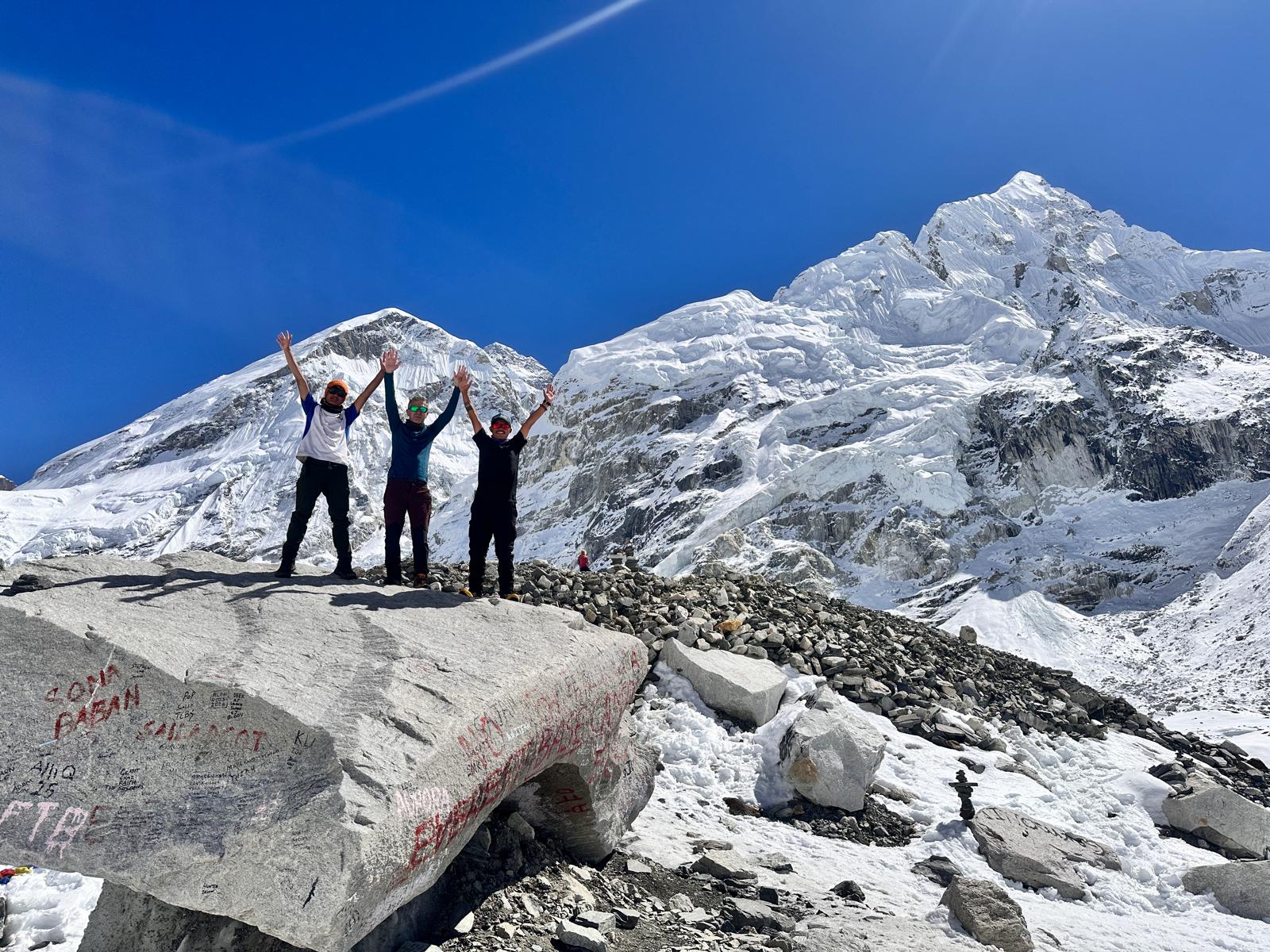
As Everest Base Camp is situated at a high altitude of 5,364 metres, you spend only 1 to 2 hours at the camp. Since the base camp lies at the foot of the world’s tallest mountain Mount Everest, the hike to EBC is probably the highlight of your trek. Though one cannot view the summit of Mount Everest from the base camp (as the mountain is too huge) you can get close up views of the massive walls of Everest, Khumbutse, Lingtren and Nuptse. The Khumbu Icefall appears spectacular. Though the icefall lies close to the Base Camp, it is not possible to explore it as you need proper climbing gear to walk on it. But you get to explore the actual base camp of the Everest expedition groups. During climbing season, it is like a mini city of tents and you get to meet mountaineers (sometimes celebrities too!) from different countries attempting to summit Mount Everest. After taking pictures and soaking in the magnificent views you descend down to Gorak Shep again. Please do note the visibility of mountains depends on the weather. If it’s foggy you may not get good views of the mountains. No, we do not spend the night at Everest Base Camp as there are no teahouses or lodges there. Moreover it is advisable and more comfortable to spend the night at a lower elevation. After enjoying the views we trek down to Gorak Shep and stay overnight at a local teahouse.
-
Can you see the summit of Mount Everest from Everest Base Camp?
No, the summit of Mount Everest is not visible from Everest Base Camp. Rising above 8000 metres, the mountain is just too gigantic to be viewed in its entirety from its base. The summit of Everest can be viewed from Kalapathar and from places en route to EBC. If you want to view Mount Everest without having to trek to Everest region, you can do it by driving to Nagarkot, taking an Everest Mountain Flight and an Everest Base Camp Helicopter Tour. The best views you get of Mount Everest is from Kalapathar. It leaves you breathless, virtually!
-
What sort of toilet facilities will be available on the Everest Trek?
In all our Everest Treks the teahouses that we use have western toilets. In luxury lodges and teahouses in the lower elevations the rooms come with attached bathrooms and hot showers. At higher elevations the facilities may be a bit basic and you may have to share the bathroom with other travellers. Please do note that in case of extreme cold, the water in the toilet basin may freeze and you may have to use an Asian (also known as ‘squat’) style of toilet that is located outside. Please do carry toilet paper rolls with you at all times. It is important that you carry enough rolls of toilet paper and hand sanitizers while trekking. Can I make payment with my credit card or with my cash while Everest trekking? You need to have local currency to purchase items on the trail. While Lukla and Namche in the Everest Region may have lodges that would accept payment with cards, we strongly advise to carry enough local cash with you to buy essential items en route. You can exchange your currency at any of the money exchange centres in Kathmandu or use your credit or debit card at the local ATMs to get local currency.
-
Where can I store my extra luggage while trekking?
You can store it at your hotel (most hotels in Kathmandu have storage facilities) or you can leave it at our office.
-
Is there WIFI available on the Everest Base Camp trail?
Yes, wifi hotspots are available on the Everest Base Camp trail. But please do keep in mind, due to the mountainous terrain the network maybe erratic sometimes. Often times the signal gets lost or the strength is poor.
Latest Traveller's Reviews
Travel experiences of our clients who recently returned from their trips.