Trip overview
Everest Three Passes Trek Overview
The 17 Days Everest Three Passes Trek is a challenging journey through the high mountains of the Khumbu region. It takes you across three major mountain passes: Renjo La (5,360 m), Cho La (5,420 m), and Kongma La (5,535 m).
The trek also takes you to Gokyo Lakes, Gokyo Ri, Everest Base Camp, and Kala Patthar. Along the way, you will walk through quiet valleys, high mountain trails, glaciers, and Sherpa villages.
This trek offers a deeper experience of the Everest region. You will leave the busy main trail at several points and explore quieter parts of the Khumbu. You will also enjoy close views of Everest, Lhotse, Makalu, Cho Oyu, and other Himalayan peaks.
Our Everest Three Passes Trek follows a carefully planned clockwise route. We cross Renjo La first, then Cho La, and finally Kongma La. This route gives you time to adjust to the altitude before reaching the highest and most demanding sections.
You will need good fitness and strong preparation for this trek. However, you do not need technical climbing skills. With proper acclimatization, a good pace, and an experienced guide, you can enjoy this challenging Himalayan adventure safely.
17 Days Everest Three Passes Trek Highlights
- Cross Renjo La Pass (5,360 m) and enjoy views of Everest, Makalu, and Cho Oyu.
- Cross Cho La Pass (5,420 m) and walk through a high Himalayan landscape.
- Cross Kongma La Pass (5,535 m), the highest and hardest pass on our route.
- Visit the beautiful Gokyo Lakes.
- Hike to Gokyo Ri (5,357 m) for a wide mountain view.
- Visit Everest Base Camp (5,364 m).
- Hike to Kala Patthar (5,545 m) for one of the best views of Mount Everest.
- Explore Sherpa villages such as Thame, Gokyo, Lobuche, and Dingboche.
- Walk through the high mountain valleys of the Everest region.
- Enjoy a quieter trail than the classic Everest Base Camp route.
Three High Passes on the Everest Three Passes Trek
The main goal of this trek is to cross three high passes. Each pass has its own character and challenge.
Renjo La Pass – 5,360 m
Renjo La is the first high pass on our clockwise route. The trail climbs from the Gokyo Valley and reaches the pass above the beautiful mountain landscape.
From the top, you can see several major peaks, including Everest, Lhotse, Makalu, and Cho Oyu.
Learn more about Renjo La Pass.
Cho La Pass – 5,420 m
Cho La connects the Gokyo Valley with the Everest Base Camp area. The trail crosses a high mountain pass and can become difficult when snow covers the route.
Good acclimatization is important before crossing Cho La. Your guide will check the trail and help you maintain a safe pace.
Read more about the Cho La Pass.
Kongma La Pass – 5,535 m
Kongma La is the highest pass on this trek. It is also the hardest section for many trekkers.
The climb is long, and the weather can change quickly. Snow and strong wind can make the crossing more difficult.
Our route crosses Kongma La after you have already visited Everest Base Camp and Kala Patthar. By this stage, you will have more time to adjust to the high altitude.
You can also read our detailed guide to Kongma La Pass.
Everest Three Passes Trek Difficulty
The Everest Three Passes Trek is challenging. It is harder than the standard Everest Base Camp Trek because you cross three passes above 5,300 m.
You will walk for about 6 to 8 hours on many trekking days. Some days can be longer, especially when you cross a high pass.
Altitude is the main challenge. You will spend several days above 4,000 m. The trail also includes steep climbs, rocky sections, snow, ice, and changing weather.
You should have good physical fitness before starting this trek. Regular walking, hiking, and cardio training can help you prepare.
You should also take altitude seriously. Our guides monitor your pace and condition throughout the trek. If you feel unwell, tell your guide at once.
You can also read our guide about Cho La Pass difficulty.
Why Choose the Everest Three Passes Trek?
The Everest Three Passes Trek gives you much more than a visit to Everest Base Camp.
First, you cross three of the most famous high passes in the Khumbu. You also visit Gokyo Lakes, Gokyo Ri, Everest Base Camp, and Kala Patthar.
The route also takes you through quieter valleys and traditional Sherpa villages. You will see a different side of the Everest region.
Another major benefit is the route itself. Our clockwise itinerary starts with Renjo La. This gives you time to gain altitude before the more demanding sections.
You will also have acclimatization days during the trek. These breaks help your body adjust to the high altitude.
For experienced trekkers, this route offers a complete Everest region adventure in one journey.
17 Days Everest Three Passes Trek Route
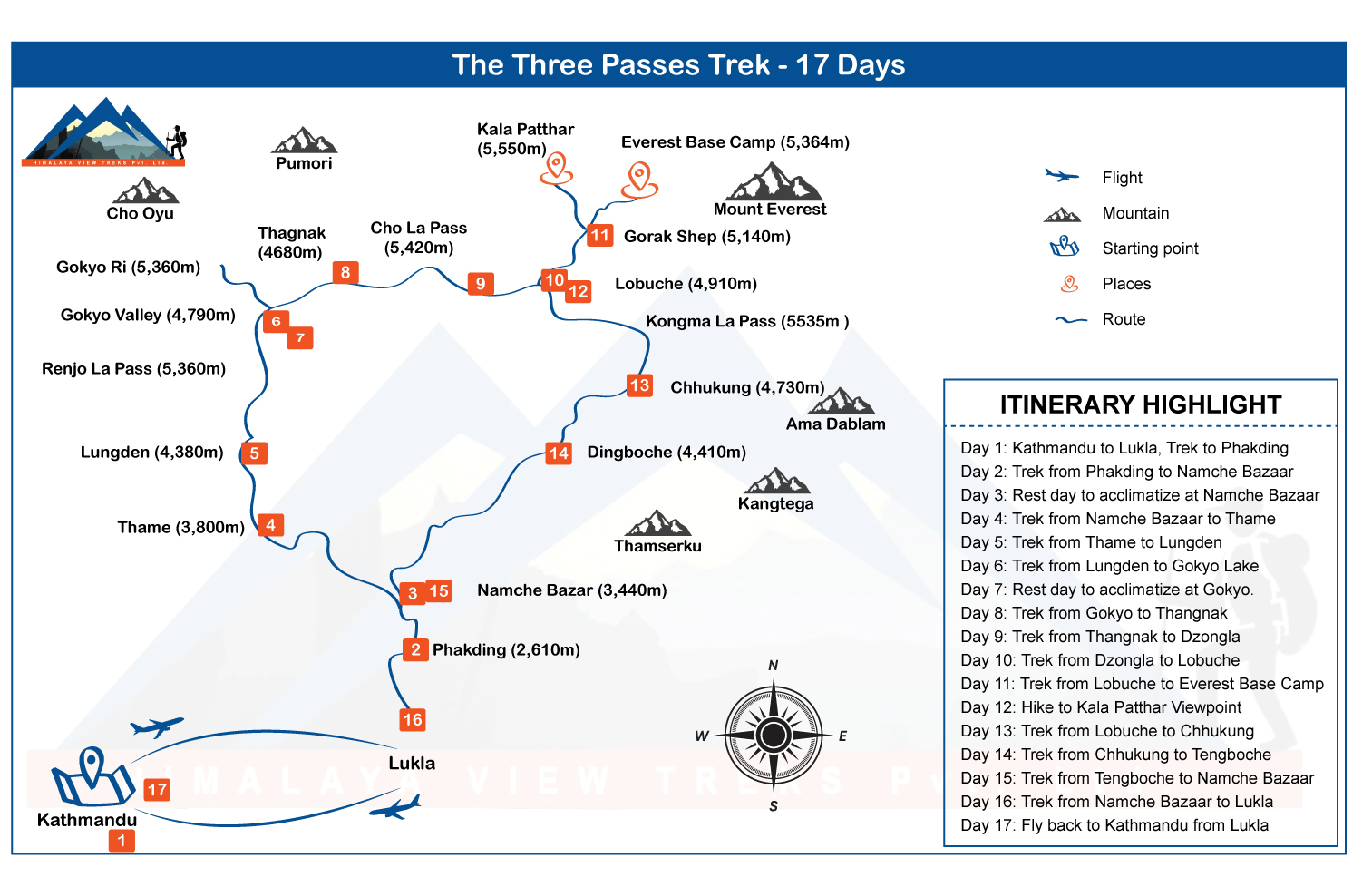
Our 17-day route Itinerary follows a clockwise direction. The trek begins with a flight from Kathmandu to Lukla.
From Lukla, you walk to Phakding and continue to Namche Bazaar. After acclimatization in Namche, the trail moves towards Thame and Lungdeng.
From Lungdeng, you cross Renjo La and enter the Gokyo Valley. You then spend time around Gokyo and hike towards Thangnak.
Next, you cross Cho La and reach Dzongla. From Dzongla, the trail continues towards Gorakshep and Everest Base Camp.
You then hike to Kala Patthar before heading towards Lobuche and Dingboche. From Dingboche, you cross Kongma La and continue towards Chhukung.
Finally, the trail returns to Namche Bazaar and Lukla before you fly back to Kathmandu.
You can learn more about Gorakshep and the Everest Base Camp route.
Best Time for the Everest Three Passes Trek
The best seasons for the Everest Three Passes Trek are spring and autumn.
Spring – March to May
Spring brings stable weather and warmer days. The trails become more comfortable as the season progresses.
You can also see rhododendrons and other flowers at lower elevations. The mountain views are often clear in the morning.
Autumn – September to November
Autumn is one of the best seasons for trekking in the Everest region. The weather is usually dry and stable.
The skies are often clear, so you can enjoy excellent views of the mountains. October and November are especially popular for high-altitude trekking.
Winter – December to February
Winter brings cold temperatures and more snow. The three passes can become difficult or unsafe when heavy snow covers the trail.
For this reason, we do not recommend the full Three Passes route in winter unless conditions are suitable and experienced local guides confirm the route.
Monsoon – June to August
The monsoon brings rain to lower areas of Nepal. Clouds can also block mountain views.
The Everest region receives less rain than many other parts of Nepal, but the high passes can still be difficult because of snow and changing weather.
Clockwise or Anti-Clockwise Route?
You can complete the Three Passes Trek in both directions. However, we recommend the clockwise route.
Our route crosses Renjo La first, followed by Cho La and Kongma La.
This order allows you to gain altitude step by step. You first spend time in Namche and Thame. Then you cross Renjo La before moving deeper into the high mountains.
After Gokyo, you cross Cho La and visit Everest Base Camp. Finally, you cross Kongma La before descending towards Chhukung and Namche.
We believe this order gives you a better flow and a more comfortable acclimatization process.
The route also gives you time to enjoy major highlights such as Gokyo Lakes, Gokyo Ri, Everest Base Camp, and Kala Patthar.
Why We Recommend the Clockwise Route
We recommend the clockwise route because it builds the trek gradually.
You begin at Lukla and spend time in Namche before moving higher. After Namche, you enter the quieter Thame Valley.
You then cross Renjo La and reach Gokyo. After an acclimatization period, you continue towards Cho La.
Once you reach the Everest Base Camp area, you hike to Kala Patthar. You then cross Kongma La before starting the descent.
This route also places the highest and hardest pass, Kongma La, later in the trek. By then, you have already spent more time at high altitude.
Gokyo Lakes and Gokyo Ri
Gokyo is one of the most beautiful areas of the Everest region. The valley is home to a group of turquoise glacial lakes surrounded by high mountains.
You also have the option to hike to Gokyo Ri (5,357 m). The viewpoint offers a wide panorama of Everest, Lhotse, Makalu, Cho Oyu, and other peaks.
You can read more about the Gokyo Ri Trek. and Fifth Lake Trek.
Everest Base Camp and Kala Patthar
The Three Passes Trek also includes two major Everest highlights.
First, you reach Everest Base Camp at 5,364 m. This is one of the main goals of the journey.
You then hike to Kala Patthar at 5,545 m. From the viewpoint, you can enjoy a close view of Mount Everest and the surrounding peaks.
The combination of the three high passes, Gokyo Valley, Everest Base Camp, and Kala Patthar makes this one of the most complete trekking routes in the Everest region.
Trek Distance and Walking Hours
The total walking distance can vary slightly because of side trips and route conditions.
Most trekking days involve around 6 to 8 hours of walking. Some days are shorter, while pass-crossing days can be longer.
The hardest days usually involve a long climb to a high pass followed by a descent. These days require good pacing and enough rest.
Mental preparation also matters. The trail can feel demanding when you are tired or when the weather changes. A steady pace and good support from your guide can make a big difference.
You can also compare this route with our Everest Base Camp Trek.
Glaciers on the Three Passes Trek
The Three Passes route takes you through several high Himalayan valleys and glacier areas.
You will see the Ngozumpa Glacier around the Gokyo Valley. The trail also passes close to the Khumbu Glacier near Everest Base Camp.
These glaciers add to the dramatic scenery of the trek. Your guide will choose the safest route based on trail and weather conditions.
Permits for the Everest Three Passes Trek
You need the required permits to enter and trek in the Everest region.
These include the Sagarmatha National Park permit and the required local entry permit for the Khumbu region.
Permit rules and fees can change. We arrange the required permits before and during the trek so you can focus on the journey.
Important Things to Know Before Three Passes Trek
The Three Passes Trek is a high-altitude adventure. Good preparation is important.
You should be ready for:
- Long walking days
- Steep climbs and descents
- High-altitude trails
- Cold temperatures
- Snow and ice
- Changing mountain weather
- Basic teahouse accommodation
- Limited facilities in remote areas
You should also bring suitable trekking clothing and footwear. Your guide can help you with practical advice before the trek starts.
Preparation for the Everest Three Passes Trek
You do not need technical climbing experience for this trek. However, you should have good fitness.
Start preparing several weeks before your trip. Regular walking, hiking, stairs, and cardio exercises can help improve your endurance.
It is also useful to practice walking for several hours with a light backpack.
Most importantly, do not rush at high altitude. Walk at a steady pace and drink enough water. Follow your guide’s advice throughout the trek.
Which Is the Hardest Pass?
Among the three passes, Kongma La is usually the hardest.
Kongma La reaches 5,535 m and involves a long climb and descent. Snow and weather can also make the crossing harder.
Cho La can also be challenging. Snow and icy sections may make the trail more difficult.
Renjo La is the lowest of the three passes, but it still requires good acclimatization because it reaches 5,360 m.
The difficulty can change with weather and trail conditions. Your guide will assess the conditions before each pass crossing.
You can also learn more about crossing the high passes.
Everest Three Passes Trek Cost
Our 17 days Everest Three Passes Trek starts from US$1,420 per person for larger groups.
The price varies by group size. A private trip for one person costs more because the guide, porter, transport, and other costs are shared by fewer people.
Our current group rates are:
- 1 person: US$1,590
- 2 people: US$1,540 per person
- 3–6 people: US$1,500 per person
- 7–10 people: US$1,460 per person
- 10-16 people: US$1,420 per person
- 16+ people: US$1,420 per person
The package includes accommodation, meals during the trek, guide, porter, permits, domestic flights, and other services listed in the inclusions section.
Why Trek with Himalaya View Treks?
Himalaya View Treks is a local trekking company based in Kathmandu. Our team has years of experience organizing trekking trips in the Everest region and other parts of Nepal.
We work with experienced and licensed guides. Our team includes local guides from different Himalayan communities, including Sherpa, Rai, Tamang, and Gurung guides.
We focus on clear planning and personal service. Before your trek, we help you prepare your permits, transport, equipment, and other trip details.
During the trek, our guide stays with you and monitors the group. We also provide first-aid support and altitude awareness.
Our service includes:
- Experienced and licensed trekking guides
- Porter service
- Airport pickup and drop-off
- Required trekking permits
- Domestic flights
- Staff insurance
- Fair wages for our trekking staff
- Free duffel bag and T-shirt
- Water purification support
- Small and private group options
- Flexible departure dates
- 24/7 support during your trip
- Trek completion certificate
- Clear and transparent pricing
We also value feedback from our guests. You can read our reviews on TripAdvisor.
Another Longer Himalayan Adventure
If you want another long Himalayan journey, you can also consider our Manaslu and Annapurna Circuit Trek – 19 Days.
This route combines the remote Manaslu region with the Annapurna Circuit. It also includes the famous Larkya La and Thorong La passes.
Read more about the Manaslu and Annapurna Circuit Trek.
Book Your Everest Three Passes Trek
The Everest Three Passes Trek is a great choice if you want to explore more than the classic Everest Base Camp route.
You will cross three high passes, visit Gokyo Lakes, hike to Gokyo Ri, reach Everest Base Camp, and climb Kala Patthar.
Our local team can help you choose the right departure date and prepare for the trek.
If you have questions about the route, cost, permits, or preparation, contact Himalaya View Treks.
You can also contact us directly through WhatsApp.
Short Itinerary
Everest Three Passes Trek - 17 Days Itinerary
Day 01: Fly to Lukla and trek to Phakding – Walking distance: 7.5 km (3–4 hours) | 2,610 m / 8,563 ft
Day 02: Phakding to Namche Bazaar – Walking distance: 12.3 km (6–7 hours) | 3,440 m / 11,283 ft
Day 03: Acclimatization Day in Namche Bazaar (Day hike to Everest View Hotel / Khumjung) | 3,440 m / 11,283 ft
Day 04: Namche Bazaar to Thame – Walking distance: ~11 km (4–5 hours) | 3,800 m / 12,467 ft
Day 05: Thame to Lungdeng (Lumde) – Walking distance: ~11 km (5–6 hours) | 4,380 m / 14,370 ft
Day 06: Lungdeng to Gokyo via Renjo La Pass (5,360 m / 17,585 ft) – Walking distance: ~10 km (6–7 hours) | 4,790 m / 15,715 ft
Day 07: Acclimatization Day in Gokyo (Hike to Gokyo Ri, 5,357 m) | 4,790 m / 15,715 ft
Day 08: Gokyo to Thangnak – Walking distance: ~4–5 km (4–5 hours) | 4,700 m / 15,420 ft
Day 09: Thangnak to Dzongla via Cho La Pass (5,420 m / 17,782 ft) – Walking distance: ~10 km (6–7 hours) | 4,830 m / 15,846 ft
Day 10: Dzongla to Gorakshep – Walking distance: ~6 km (4–5 hours) | 5,164 m / 16,942 ft
Day 11: Visit Everest Base Camp (5,364 m) and return to Gorakshep – Walking distance: ~8 km (5–6 hours) | 5,164 m / 16,942 ft
Day 12: Hike to Kala Patthar (5,545 m / 18,192 ft) early morning, then trek to Lobuche – Walking distance: ~8 km (5–6 hours) | 4,910 m / 16,109 ft
Day 13: Lobuche to Chhukung via Kongma La Pass (5,535 m / 18,159 ft) – Walking distance: ~12 km (6–8 hours) | 4,730 m / 15,518 ft
Day 14: Chhukung to Tengboche – Walking distance: ~13 km (5–6 hours) | 3,860 m / 12,664 ft
Day 15: Tengboche to Namche Bazaar – Walking distance: ~10 km (4–5 hours) | 3,440 m / 11,283 ft
Day 16: Namche Bazaar to Lukla – Walking distance: ~19 km (7–8 hours) | 2,860 m / 9,383 ft
Day 17: Fly from Lukla to Kathmandu – Flight time: 30–35 minutes | 1,400 m / 4,593 ft
Detailed Itinerary
Day 01: Fly to Lukla and Trek to Phakding (2,610 m / 8,563 ft)
Walking Distance: Approximately 7.5 km
Trekking Duration: 3–4 hours
Maximum Elevation: 2,610 m / 8,563 ft
Your Everest Three Passes Trek begins with an exciting flight from Kathmandu or Ramechhap to Lukla, depending on the flight schedule and season. During the flight, you can enjoy spectacular views of the Himalayan mountains before landing at Tenzing-Hillary Airport in Lukla.
After meeting your trekking guide and organizing your equipment, you will begin walking through the beautiful Khumbu region. The trail descends gradually through Chheplung and other traditional Sherpa settlements, passing mani walls, prayer wheels, small monasteries, and suspension bridges.
You will follow the Dudh Koshi River through a landscape of pine trees, terraced fields, and mountain villages. After a few hours of walking, you will reach Phakding, a peaceful village where you can rest, enjoy dinner, and prepare for the following day's trek to Namche Bazaar.
Overnight: Lodge in Phakding.
Day 02: Phakding to Namche Bazaar (3,440 m / 11,283 ft)
Walking Distance: Approximately 12.3 km
Trekking Duration: 6–7 hours
Maximum Elevation: 3,440 m / 11,283 ft
After breakfast in Phakding, you will continue along the Dudh Koshi River, crossing several suspension bridges and passing through villages such as Toktok, Benkar, and Monjo. The trail offers beautiful views of forested hills, waterfalls, and surrounding mountain peaks.
At Monjo, you will enter Sagarmatha National Park, where your permits may be checked. You will then descend toward Jorsalle, a riverside settlement where you can stop for lunch before continuing toward Namche Bazaar.
The route crosses the famous Hillary Suspension Bridge, one of the most memorable landmarks along the Everest trekking trail. Beyond the bridge, the trail climbs steadily through pine and rhododendron forests toward Namche Bazaar. If the weather is clear, you may catch your first views of Mount Everest along the way.
Namche Bazaar is the main trading center of the Khumbu region, with lodges, bakeries, shops, and spectacular mountain scenery. After arriving, you can relax and enjoy the atmosphere of this lively Sherpa town.
Overnight: Lodge in Namche Bazaar.
Day 03: Acclimatization Day in Namche Bazaar (3,440 m / 11,283 ft)
Walking Distance: Approximately 3–6 km, depending on the hike
Hiking Duration: 2–4 hours
Sleeping Elevation: 3,440 m / 11,283 ft
Today is an important acclimatization day to help your body adjust to the increasing altitude. Rather than remaining indoors all day, you will take a gradual hike to a higher elevation before returning to Namche Bazaar to sleep.
One popular option is a hike toward the Everest View Hotel, situated at approximately 3,880 m / 12,730 ft. From this viewpoint, you can enjoy panoramic views of Mount Everest, Ama Dablam, Lhotse, and other Himalayan peaks when the weather is clear.
You may also visit Khumjung, a traditional Sherpa village known for its monastery, stone houses, and local culture. Depending on your pace and conditions, you can explore the village before returning to Namche.
The rest of the day is available for relaxing, visiting local shops, enjoying a warm drink at a bakery, or learning more about Sherpa traditions. Drink enough fluids, eat well, and avoid overexertion as you prepare for the higher elevations ahead.
Overnight: Lodge in Namche Bazaar.
Day 04: Namche Bazaar to Thame (3,800 m / 12,467 ft)
Walking Distance: Approximately 11 km
Trekking Duration: 4–5 hours
Maximum Elevation: 3,800 m / 12,467 ft
After breakfast, you will leave the busy streets of Namche Bazaar and follow the quieter trail toward Thame. This route branches away from the main Everest Base Camp trail and takes you into a less crowded part of the Khumbu region.
The trail passes through small Sherpa settlements, stone-walled fields, and open hillsides with views of the surrounding mountains. Along the way, you may encounter yak pastures, traditional houses, mani walls, and prayer flags fluttering in the mountain breeze.
As you continue toward Thame, the landscape becomes increasingly peaceful, offering a glimpse of traditional Himalayan village life away from the busier trekking routes. Thame is an important Sherpa settlement associated with mountaineering and the region's Buddhist heritage.
If time and conditions permit, you can explore the village and visit Thame Monastery, a significant spiritual site in the area. Your guide can explain its cultural importance and help you plan a visit.
Overnight: Lodge in Thame.
Day 05: Thame to Lungdeng (Lumde) (4,380 m / 14,370 ft)
Walking Distance: Approximately 11 km
Trekking Duration: 5–6 hours
Maximum Elevation: 4,380 m / 14,370 ft
Today, you will continue deeper into the remote Bhote Koshi Valley, following the historic trading route toward the Nangpa La region near the Nepal–Tibet border. Compared with the main Everest Base Camp trail, this section is quieter and offers a more remote Himalayan trekking experience.
After leaving Thame, the trail gradually climbs through rugged mountain terrain, past small settlements, yak pastures, and traditional stone shelters. You will notice fewer trees as the landscape becomes more open and alpine.
Along the way, you can enjoy views of surrounding peaks, rocky slopes, and the broad valley carved by the Bhote Koshi River. The steady ascent makes this a demanding day, especially as you approach 4,000 m and above.
You will eventually reach Lungdeng, also known as Lumde, a small settlement used by trekkers preparing to cross Renjo La Pass. Take time to rest, eat well, and prepare your clothing and equipment for the high mountain pass the following day.
Overnight: Basic lodge or teahouse in Lungdeng, subject to seasonal availability.
Day 06: Lungdeng to Gokyo via Renjo La Pass (5,360 m / 17,585 ft)
Walking Distance: Approximately 10 km
Trekking Duration: 6–7 hours
Highest Elevation: Renjo La Pass, 5,360 m / 17,585 ft
Sleeping Elevation: Gokyo, approximately 4,790 m / 15,715 ft
Today is one of the major highlights of the Everest Three Passes Trek as you cross the spectacular Renjo La Pass. You will start early, allowing enough time to climb gradually toward the pass and descend to Gokyo.
From Lungdeng, the trail ascends through rocky terrain and high-altitude landscapes. As you gain elevation, the path becomes steeper and more demanding, so maintaining a steady pace and taking regular breaks is important.
After reaching Renjo La Pass at approximately 5,360 m, you can enjoy breathtaking views of Everest, Lhotse, Makalu, and the surrounding Himalayan peaks, weather permitting. The pass also provides a remarkable view of the turquoise Gokyo Lakes and the Ngozumpa Glacier.
After taking time to appreciate the scenery, you will begin the descent toward Gokyo. The trail crosses rocky slopes and high-mountain terrain before reaching the beautiful Gokyo Valley.
Gokyo is situated beside a series of glacial lakes and offers an unforgettable setting surrounded by snow-covered mountains. After arriving, you can rest at your teahouse and enjoy a well-earned meal following this challenging day.
Overnight: Lodge in Gokyo.
Day 07: Acclimatization Day in Gokyo and Hike to Gokyo Ri (5,357 m / 17,575 ft)
Walking Distance: Approximately 3–5 km, depending on the route
Hiking Duration: 3–5 hours
Highest Elevation: Gokyo Ri, approximately 5,357 m / 17,575 ft
Sleeping Elevation: Gokyo, approximately 4,790 m / 15,715 ft
Today offers an opportunity to acclimatize further while exploring one of the most famous viewpoints in the Everest region. If you are feeling well and conditions are suitable, you can hike to Gokyo Ri, a prominent hill overlooking the Gokyo Valley.
The ascent is steep and can be physically demanding because of the altitude. You will climb slowly, taking breaks as needed and following your guide's advice. From the summit, you can enjoy panoramic views of Mount Everest, Lhotse, Makalu, Cho Oyu, the Ngozumpa Glacier, and the turquoise Gokyo Lakes.
The views are particularly impressive in clear weather, with the glacial landscape stretching across the valley below. After spending time at the viewpoint, you will descend to Gokyo.
If you prefer a gentler day or need additional rest, you can explore the lakeside area instead of climbing all the way to Gokyo Ri. Your guide can help decide the most suitable option based on your condition and the weather.
The remainder of the day is available for resting, enjoying the mountain scenery, and preparing for the next section of the trek toward Cho La Pass.
Overnight: Lodge in Gokyo.
Day 08: Gokyo to Thangnak (4,700 m / 15,420 ft)
Walking Distance: Approximately 4–5 km
Trekking Duration: 4–5 hours
Maximum Elevation: Approximately 4,700 m / 15,420 ft
After breakfast, you will leave Gokyo and continue toward Thangnak, also known as Dragnag. Although the walking distance is relatively short, the route crosses rugged glacial terrain and requires careful footing.
The trail takes you toward the edge of the Ngozumpa Glacier, one of the largest glaciers in the Himalayas. Depending on the current route and trail conditions, you will cross rocky moraine terrain and navigate uneven surfaces while following your guide's directions.
This section can be slower than expected because of loose stones, changing trail conditions, and the high altitude. Take your time, maintain a steady pace, and avoid rushing across the rocky ground.
Thangnak is a small settlement located beneath the surrounding mountains and serves as an important overnight stop before crossing Cho La Pass. After reaching your lodge, you can rest, eat an early dinner, and prepare for an early start the following morning.
Your guide will assess the weather and trail conditions before the Cho La crossing, as snow, ice, and visibility can affect the difficulty of the route.
Overnight: Basic lodge or teahouse in Thangnak.
Day 09: Thangnak to Dzongla via Cho La Pass (5,420 m / 17,782 ft)
Walking Distance: Approximately 10 km
Trekking Duration: 6–7 hours
Highest Elevation: Cho La Pass, approximately 5,420 m / 17,782 ft
Sleeping Elevation: Dzongla, approximately 4,830 m / 15,846 ft
Today, you will cross Cho La Pass, the second major high mountain pass on your Everest Three Passes Trek. The day begins early because the route is challenging and conditions can change quickly at high altitude.
From Thangnak, the trail climbs across rocky slopes toward Cho La Pass. The ascent becomes steeper as you approach the pass, and sections may involve snow, ice, or slippery rocks depending on the season. Your guide will help you navigate the terrain and determine whether conditions are safe for crossing.
At the top of Cho La Pass, you can enjoy dramatic views of the surrounding Himalayan peaks and glaciers. The high-altitude setting provides a memorable sense of achievement after the demanding climb.
After crossing the pass, you will descend carefully toward Dzongla. The descent can be challenging, especially when snow or ice is present, so allow enough time and follow your guide's instructions.
Dzongla is a small settlement surrounded by rugged mountain scenery. Upon arrival, you can rest and recover before continuing toward Lobuche and the Everest Base Camp section of the trek.
Overnight: Lodge in Dzongla.
Day 10: Dzongla to Lobuche
After breakfast in Dzongla, you will continue your Everest Three Passes Trek toward Lobuche. The trail gradually ascends and descends across rocky terrain, offering spectacular views of Cholatse, Taboche, and the surrounding Himalayan peaks. As you leave Dzongla, you will follow a scenic mountain trail that eventually joins the main Everest Base Camp route near Lobuche.
Along the way, you can enjoy the dramatic landscape of glacial valleys, rugged hillsides, and snow-covered mountains. The trail becomes increasingly busy as you approach Lobuche, where trekkers gather before continuing toward Everest Base Camp and Kala Patthar. After arriving, you can rest at your teahouse, enjoy a warm meal, and prepare for the next day's journey toward Gorak Shep.
Walking distance: Approximately 7–8 km | Trekking duration: 3–4 hours | Elevation: Lobuche, 4,910 m (16,109 ft)
Day 11: Lobuche to Everest Base Camp and Return to Gorak Shep
Today is one of the major highlights of your Everest Three Passes Trek. After an early breakfast, you will follow the trail from Lobuche toward Gorak Shep, passing through a rugged landscape shaped by glaciers and towering Himalayan peaks. The trail gradually climbs across rocky moraine terrain, so you will need to maintain a steady pace at this altitude.
After reaching Gorak Shep, you will take a short break before continuing toward Everest Base Camp at 5,364 m (17,598 ft). The trail follows the Khumbu Glacier, offering remarkable views of the surrounding mountains and glacial formations. At Everest Base Camp, you can celebrate reaching this iconic destination and enjoy views of the Khumbu Icefall and nearby Himalayan peaks, although Mount Everest's summit is not clearly visible from the base camp itself.
After spending time exploring the area and taking photographs, you will retrace your steps to Gorak Shep for an overnight stay. The high altitude makes this a demanding day, so walking slowly and following your guide's advice is essential.
Walking distance: Approximately 12–15 km | Trekking duration: 7–9 hours | Highest elevation: Everest Base Camp, 5,364 m (17,598 ft) | Overnight elevation: Gorak Shep, 5,164 m (16,942 ft)
Day 12: Gorak Shep to Kala Patthar and Trek to Lobuche
You will start early in the morning for a hike to Kala Patthar, one of the best viewpoints in the Everest region. The climb is steep and physically demanding because of the high altitude, but the spectacular mountain scenery makes the effort rewarding.
From the viewpoint, you can enjoy panoramic views of Mount Everest, Nuptse, Pumori, and the surrounding Himalayan peaks, weather permitting. Kala Patthar reaches approximately 5,545 m (18,192 ft), making this one of the highest points of your trek.
After enjoying the sunrise and taking photographs, you will descend to Gorak Shep for breakfast. You will then continue downhill toward Lobuche, retracing part of the trail through the glacial valley. The descent provides an opportunity to recover from the previous day's demanding hike while enjoying the surrounding mountain scenery.
Upon reaching Lobuche, you can relax at your teahouse and prepare for the next section of the Three Passes route toward Kongma La.
Walking distance: Approximately 8–10 km | Trekking duration: 5–7 hours | Highest elevation: Kala Patthar, 5,545 m (18,192 ft) | Overnight elevation: Lobuche, 4,910 m (16,109 ft)
Day 13: Lobuche to Chhukung via Kongma La Pass
Today, you will cross Kongma La Pass, the third and final major pass of your Everest Three Passes Trek. After an early breakfast, you will leave Lobuche and follow a challenging trail across rocky terrain and high-altitude glacial landscapes. This route is generally quieter than the main Everest Base Camp trail and offers a more remote mountain trekking experience.
The ascent toward Kongma La Pass is demanding, with steep sections and loose stones. Depending on the season, you may encounter snow or ice, so careful footing and guidance from your trekking guide are important. From the pass at approximately 5,535 m (18,159 ft), you can enjoy magnificent views of surrounding Himalayan peaks, glaciers, and the dramatic mountain valleys.
After crossing the pass, you will descend carefully toward the Imja Valley and continue to Chhukung, a small settlement surrounded by impressive mountain scenery. This is a long and strenuous day, particularly because of the altitude and challenging terrain. Once you arrive, you can rest and enjoy a warm meal at your teahouse.
Walking distance: Approximately 10–12 km | Trekking duration: 7–9 hours | Highest elevation: Kongma La Pass, 5,535 m (18,159 ft) | Overnight elevation: Chhukung, approximately 4,730 m (15,518 ft)
Day 14: Chhukung to Tengboche
After breakfast, you will leave Chhukung and descend through the beautiful Imja Valley toward Dingboche. Along the way, you can enjoy views of Ama Dablam, Lhotse, and other surrounding Himalayan peaks. The trail passes through alpine landscapes, stone-walled fields, and traditional Sherpa settlements.
From Dingboche, you will continue toward Pangboche, one of the region's traditional Sherpa villages. The route offers opportunities to appreciate local Buddhist culture, mountain scenery, and the changing landscape as you descend to lower elevations.
You will then follow the trail through forests and hillside paths toward Tengboche, home to the famous Tengboche Monastery. If time permits, you can visit the monastery and learn about its importance to the Sherpa community and Buddhist traditions in the Khumbu region.
After reaching Tengboche, you can relax at your lodge and enjoy views of the surrounding mountains.
Walking distance: Approximately 12–15 km | Trekking duration: 5–7 hours | Elevation: Tengboche, 3,860 m (12,664 ft)
Day 15: Tengboche to Namche Bazaar
After breakfast, you will leave Tengboche and follow the trail downhill through rhododendron and pine forests. The route passes through Debuche and crosses suspension bridges over the Dudh Koshi River before continuing through traditional Sherpa settlements.
Along the way, you can enjoy beautiful views of Ama Dablam, Thamserku, and other Himalayan peaks. You will pass through Phunki Tenga and gradually ascend toward the trail leading back to Namche Bazaar. Although much of the route involves descending, some uphill sections require additional effort.
Upon reaching Namche Bazaar, you can spend the afternoon relaxing, visiting local shops, enjoying a bakery, or exploring the lively streets of this mountain town. After several challenging days crossing the high passes, this is a good opportunity to rest and enjoy the comforts of the village.
Walking distance: Approximately 9–10 km | Trekking duration: 4–5 hours | Elevation: Namche Bazaar, 3,440 m (11,283 ft)
Day 16: Namche Bazaar to Lukla
Today, you will continue your journey back toward Lukla, retracing the trail through the Dudh Koshi Valley. After breakfast, you will descend from Namche Bazaar toward the Hillary Suspension Bridge, crossing several suspension bridges and passing through forests and small villages.
The route continues through Jorsalle and Monjo, where you will leave Sagarmatha National Park after the necessary permit checks. You will then pass through Benkar, Phakding, and other settlements along the river valley before following the final uphill sections toward Lukla.
Although the trail is mostly downhill, the distance and repeated ascents and descents can make this a tiring day. Along the way, you can reflect on your achievement of crossing Renjo La, Cho La, and Kongma La passes and exploring the spectacular landscapes of the Everest region.
After reaching Lukla, you can celebrate the completion of your trekking journey with your guide and crew.
Walking distance: Approximately 18–20 km | Trekking duration: 6–8 hours | Elevation: Lukla, 2,860 m (9,383 ft)
Day 17: Fly from Lukla to Kathmandu
After breakfast, you will head to Lukla Airport for your return flight to Kathmandu or Ramechhap, depending on the flight schedule and seasonal arrangements. If the weather is clear, you may enjoy one final aerial view of the Himalayan mountains, deep valleys, and green hills.
After landing, you can transfer to your hotel in Kathmandu or continue with your onward travel arrangements. Your Everest Three Passes Trek concludes with unforgettable memories of high mountain passes, glacial lakes, traditional Sherpa villages, and some of the most spectacular scenery in the Himalayas.
Flight duration: Approximately 30–40 minutes to Kathmandu when operating directly; flights may instead operate via Ramechhap, requiring an additional road transfer.
Included
- Airport pickup and drop as per client’s arrival and departure date
- Hotel- domestic airport- hotel by car/ van, depend on group sizes
- Domestic flights (Kathmandu - Lukla - Kathmandu) tickets including airport taxes
- All meals (Breakfast, lunch, and dinner) during your Everest Three passes Trek
- 14 nights Hotel Accommodation during Everest Three passes Trek
- Government licensed holder, fluent English Speaking, Familiar HVT guide
- Assistant guide if Group sizes is more than 10 trekkers)
- Guide and Porter wages including their meals, accommodation, and Salary
- Staff insurance including medication coverage
- Guide and Assistance both ways Lukla flight Ticket
- Strong local porter service to carry trekkers’ luggage — one porter for every two trekkers. Porter service is not included for solo travellers and can be arranged at an additional cost upon request.
- Water purification drop or tablets for safe drinking water
- Sagarmatha National Park entry permit fee
- Khumbu Pashang Lhamu Rural Municipality permits fees
- Seasonal fresh fruits every day during Everest Three passes trek
- Oximeter to measure Pulse and oxygen level
- Himalaya View Treks Company T-shirt as a Souvenirs and duffel bag if you needed
- Safe storing at company store during the trek
- Local government, taxes, including official Service Charge
- Trip completion Certificate
Not Included
- Hotel accommodation and meals In Kathmandu
- Personal expense (shopping, snacks, boil bottle water, hot (tea, coffee) and cold drinks, hot shower, Wi-Fi, telephone call, battery charge fee during the Everest three passes Trek)
- Personal clothing and trekking gear
- Sleeping bag and down jacket available for rent in our store
- Personal travel insurance including evacuation coverage (compulsory) up to 6000m)
- Additional costs if delays flights and outside the itinerary
- All the costs and expenses which are not mentioned in includes list
- Tips for Guide and Porters at the end of the treks
Useful Info
Useful Information for Everest Three Passes Trek
Travel Insurance
Travel insurance is mandatory for this trek. Your policy must cover emergency helicopter evacuation, medical expenses, and high-altitude trekking (up to 6,000m). Acute Mountain Sickness (AMS) or injuries can occur where no other transportation is available, so having proper insurance is vital. Keep a copy of your insurance policy with you and leave one at home or with your trekking agency. You should also bring a personal first-aid kit for basic medical needs.
Equipment List for the Everest High Passes Trek
Below is a recommended list of essential gear for your trek. You may have personal preferences, but these items are important for comfort and safety.
Footwear
Sturdy, waterproof trekking boots (well broken-in)
Comfortable walking shoes or trainers
Warm trekking socks
Gaiters (for snow or rain)
Legwear
Lightweight trekking trousers
Thermal leggings for cold areas
Waterproof pants
(For women) Long skirt as an alternative option
Bodywear
Moisture-wicking T-shirts and long-sleeved shirts (avoid cotton)
Thermal base layers
Fleece or wool sweaters
Insulated down jacket (can be rented in Kathmandu)
Windproof and waterproof shell jacket
Head & Handwear
Warm hat or balaclava
Sun hat or cap
Sunglasses or goggles
Warm gloves
Other Essentials
Rucksack or duffel bag (carried by porters)
Daypack for personal items
Plastic/stuff sacks for organizing gear
1-liter water bottle
Sleeping bag (4-season recommended)
Headlamp or torch
Toiletries, towel, and personal hygiene items
Camera or smartphone for photos
Basic first-aid kit
Optional Items
Trekking poles
Binoculars
Reading material or playing cards
Altimeter or compass
Lightweight entertainment (music, journal, etc.)
Most importantly, bring: An open mind, a sense of humor, and a spirit of adventure — because trekking in Nepal is not just about mountains, but about embracing a different world.
Entrance Permits & Fees
To enter the Everest region, you will need the following permits:
Khumbu Pasang Lhamu Rural Municipality Permit
Sagarmatha National Park Entry Permit
Both can be arranged through your trekking agency or purchased en route.
Trip Map